Mukhyamantri Saur Swarojgar Yojana (MSSY)
The Uttarakhand government introduced the Mukhyamantri Saur Swarojgar Yojana to support small and marginal farmers and young entrepreneurs impacted by the COVID-19 pandemic by helping them establish a stable and reliable source of monthly income.
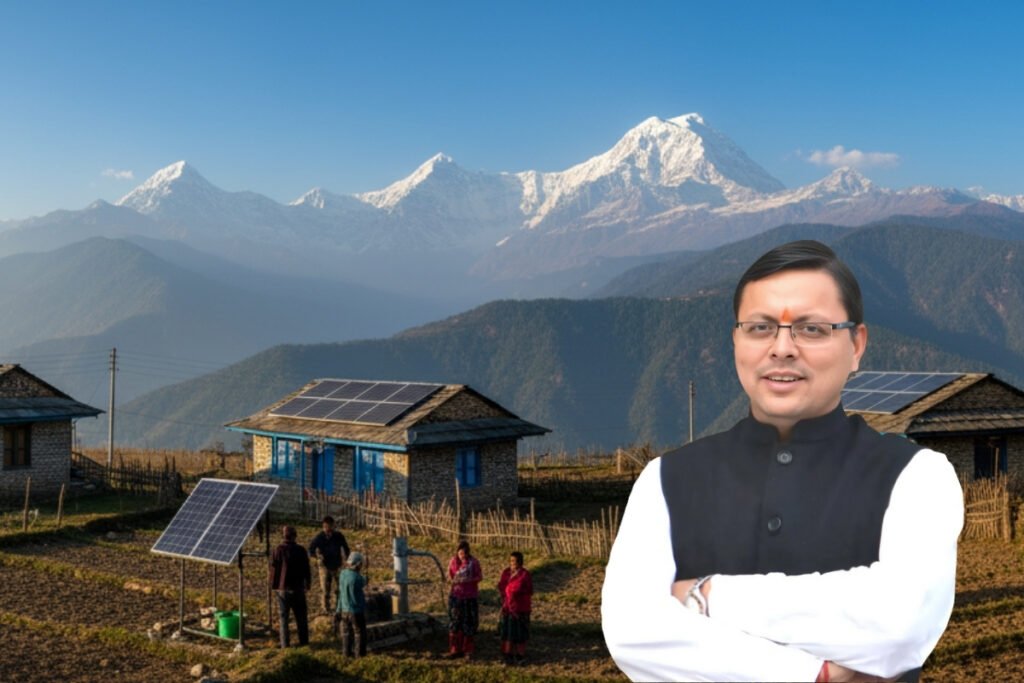
Under the Mukhyamantri Saur Swarojgar Yojana (MSSY), barren or mountainous land—where traditional farming is difficult—can be utilized to set up solar power projects, generating a passive income of up to ₹1.5 lakh per month*. To encourage participation, the state government also provides financial support in the form of loans and subsidies, making solar installation more accessible and affordable.
Financing the Solar Plant
Under the Mukhyamantri Saur Swarojgar Yojana, the cost of installing a solar power plant ranges from ₹10 lakh to ₹1 crore, based on a benchmark rate of ₹50,000 per kilowatt for systems sized between 20 kW and 200 kW. To support beneficiaries, up to 75% of the project cost is available as a loan from government banks at interest rates of up to 9% per annum, with a maximum repayment tenure of 15 years. In addition, the Uttarakhand government offers capital subsidies of up to 50% on the solar plant cost under the Chief Minister Self-Employment Scheme managed by the MSME Department. The state government also provides interest subsidies, covering a portion of the loan interest. Both capital and interest subsidies under the Mukhyamantri Saur Swarojgar Yojana vary based on the location of the solar plant, further enhancing the overall financial benefits for eligible applicants.
Objectives:- The Mukhyamantri Swarojgar Yojana 2.0 (MSY 2.0) aims to create widespread employment opportunities across Uttarakhand by enabling the youth, women, artisans, migrants, and unemployed individuals to establish self-owned enterprises
- Providing bank loans and subsidies for setting up manufacturing, service, or trade businesses.
- Encouraging migrants and youth to become job creators instead of job seekers.
- Promoting women entrepreneurship with extra financial support.
- Reducing unemployment and migration by promoting local-level self-employment.
- Supporting the manufacturing of ODOP/ODTP/GI-tagged local products through additional incentives.
- Enhancing access to credit and ensuring ease of doing business via a simplified and transparent process.